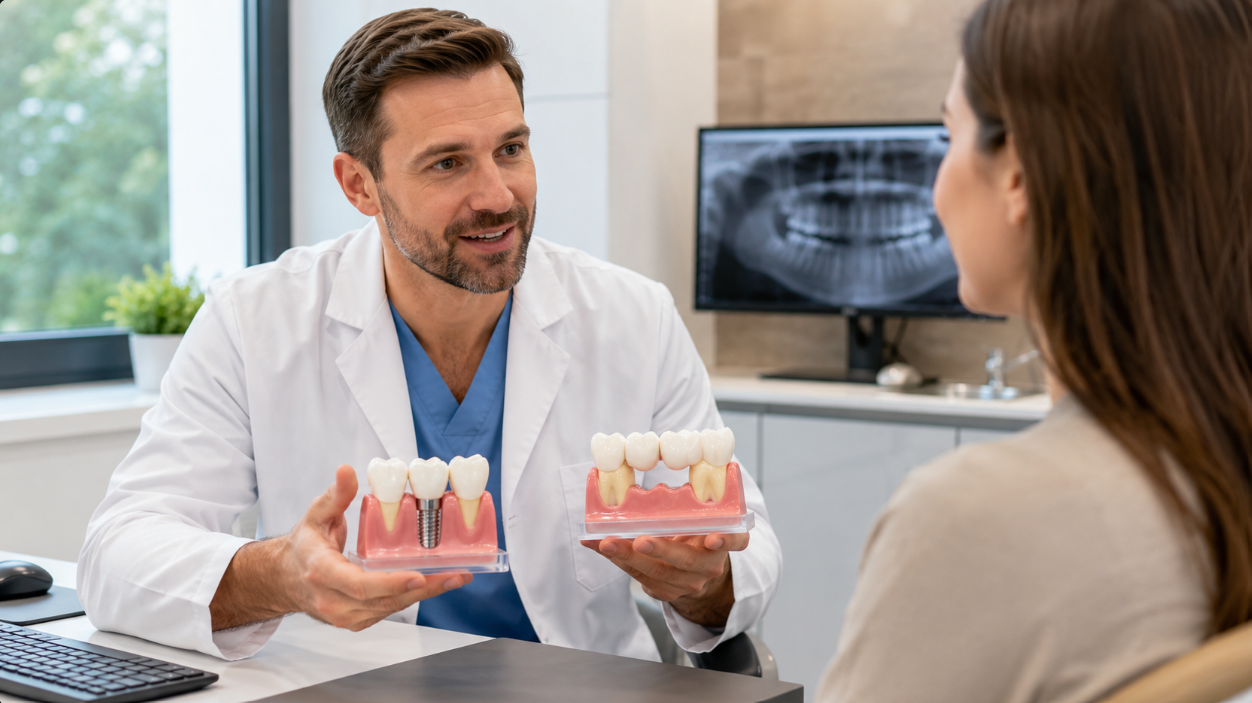
Losing a tooth can affect more than the way your smile looks. A missing tooth can change how you chew, how your bite feels, and how confident you feel when speaking or smiling. It may also allow nearby teeth to shift into the open space over time.
Two of the most common ways to replace a missing tooth are a dental implant and a dental bridge. Both can restore the appearance of your smile and help improve function, but they work in very different ways.
A dental implant replaces the missing tooth root and supports a custom crown. A dental bridge fills the space by using nearby teeth as support. The better option depends on your oral health, bone support, neighboring teeth, timeline, budget, and long-term goals.
At Park Ave Dental Group, patients in Weehawken, NJ can receive personalized guidance on tooth replacement options. If you are deciding between a dental implant and a bridge, this guide will help you understand the key differences before your consultation.
Why Replacing a Missing Tooth Matters
It can be tempting to delay replacing a missing tooth, especially if the gap is not visible when you smile. However, even one missing tooth can affect your oral health over time.
A missing tooth may lead to:
- Shifting of nearby teeth
- Changes in your bite
- Difficulty chewing on one side
- Extra stress on remaining teeth
- Food trapping in the open space
- Jawbone changes in the area of tooth loss
- Changes in smile appearance
- Speech changes in some cases
Replacing the tooth helps restore function and prevent the surrounding teeth from moving into the empty space. The right treatment can also improve comfort and confidence.
Park Ave Dental Group has more information on this topic in its related article, Single Tooth Implant: Why Replacing One Missing Tooth Matters.
What Is a Dental Implant?
A dental implant is a small post that is placed in the jawbone to act as a replacement tooth root. After the implant integrates with the bone, it can support a crown, bridge, or denture, depending on how many teeth need to be replaced.
For a single missing tooth, the implant is usually restored with a custom dental crown. The goal is to replace the missing tooth in a way that looks natural and functions comfortably.
A dental implant typically includes three main parts:
- The implant post, which replaces the tooth root
- The abutment, which connects the implant to the restoration
- The crown, which is the visible replacement tooth
Dental implants are often recommended because they do not require reshaping the neighboring teeth. They also help replace the tooth root, which can support the jawbone in the area of the missing tooth.
You can learn more about implant care through Park Ave Dental Group’s dental implant services.
What Is a Dental Bridge?
A dental bridge is a fixed restoration that fills the space left by one or more missing teeth. A traditional bridge usually uses the teeth on either side of the gap as support. These supporting teeth are prepared for crowns, and the replacement tooth is attached between them.
The replacement tooth is called a pontic. The teeth that support the bridge are called abutment teeth.
A dental bridge may be recommended when:
- A patient wants a fixed tooth replacement
- Neighboring teeth already need crowns
- Bone support may not be ideal for an implant
- Surgery is not preferred or not recommended
- A faster tooth replacement option is desired
- The patient is not a good candidate for implant treatment
A bridge can restore appearance and chewing ability, but it does not replace the missing tooth root. Because it relies on neighboring teeth, the health of those teeth is an important part of the decision.
Dental Implant vs. Bridge: The Main Difference
The main difference between a dental implant and a bridge is how each option is supported.
A dental implant is supported by the jawbone. It replaces the root area of the missing tooth and supports a crown independently.
A dental bridge is supported by nearby teeth. It fills the missing space with an artificial tooth, but the restoration depends on the adjacent teeth for stability.
This difference matters because it affects treatment planning, long-term maintenance, cost, timeline, and how much the surrounding teeth are involved.
Benefits of a Dental Implant
Dental implants can be a strong tooth replacement option for many patients. They are designed to function like an artificial tooth root and can support a natural-looking restoration.
A Dental Implant Does Not Usually Require Reshaping Healthy Neighboring Teeth
One of the biggest advantages of a single dental implant is that it typically does not require preparing the teeth next to the missing space. If the neighboring teeth are healthy, this can be an important benefit.
With a traditional bridge, the adjacent teeth often need to be reshaped to support crowns. With an implant, the replacement tooth can stand independently.
Dental Implants Help Support Jawbone Health
When a natural tooth is lost, the jawbone in that area no longer receives the same stimulation from chewing. Over time, the bone may change or shrink in the area of the missing tooth.
Because a dental implant replaces the tooth root, it can help maintain support in the jawbone where the tooth was lost. This is one reason implants are often considered for long-term tooth replacement.
Dental Implants Can Feel Stable
Once healed and restored, an implant-supported crown can feel stable when chewing and speaking. Many patients appreciate that the replacement tooth does not depend on neighboring teeth for support.
Dental Implants Can Be a Long-Term Option
Dental implants are often considered a long-term tooth replacement option when patients have healthy gums, enough bone support, and good oral hygiene. However, they still require routine dental care and maintenance.
Implants are not “set it and forget it.” Regular dental exams, cleanings, and good home care are important for protecting the gums, bone, and restoration.
Things to Consider Before Choosing a Dental Implant
Dental implants can be an excellent option, but they are not right for every patient.
Your dentist will need to evaluate:
- Jawbone support
- Gum health
- Medical history
- Smoking or tobacco use
- Bite pressure
- Oral hygiene habits
- Healing ability
- Whether bone grafting is needed
- Timeline and budget
Some patients may need additional procedures before implant placement, such as bone grafting or treatment for gum disease. These steps can add time to the overall process.
Benefits of a Dental Bridge
A dental bridge can also be a reliable option for replacing a missing tooth. In some cases, it may be the more practical or appropriate choice.
A Bridge May Be Completed Faster
A dental bridge often has a shorter treatment timeline than an implant because it does not require implant healing and integration with the jawbone. For patients who want a fixed replacement in less time, this can be appealing.
A Bridge May Be Helpful When Nearby Teeth Need Crowns
If the teeth next to the missing space already have large fillings, cracks, or need crowns, a bridge may restore those teeth while also replacing the missing tooth.
In that situation, using the neighboring teeth for support may make sense because those teeth already need restorative treatment.
A Bridge Does Not Require Implant Surgery
Some patients prefer to avoid oral surgery, or they may not be good candidates for implant placement because of health, bone, or healing concerns. A bridge may provide a fixed alternative that does not involve placing an implant in the jawbone.
A Bridge Can Restore Smile Appearance and Chewing Function
A well-made bridge can fill the visible gap, help restore chewing function, and improve the appearance of the smile. The dentist will design the bridge to fit your bite and blend with nearby teeth.
Things to Consider Before Choosing a Bridge
A dental bridge also has limitations. Since it relies on neighboring teeth, those teeth need to be strong and healthy enough to support the restoration.
Things to consider include:
- Adjacent teeth may need to be reshaped
- The bridge does not replace the tooth root
- Cleaning under the bridge requires special care
- Supporting teeth can still develop decay or gum problems
- The bridge may need replacement over time
- Bone changes may still occur under the missing tooth area
Your dentist can help you understand whether your neighboring teeth are good candidates to support a bridge.
Which Option Looks More Natural?
Both dental implants and bridges can be designed to look natural. The final appearance depends on the material, shade match, shape, gumline, and the skill of the dental team creating the restoration.
For a single missing tooth, an implant crown can often look very natural because it emerges from the gumline similarly to a natural tooth. A bridge can also look natural, especially when carefully designed to match the surrounding teeth.
If your missing tooth is in the front of your mouth, cosmetic planning becomes especially important. Your dentist will consider tooth color, shape, symmetry, gum contours, and how the restoration fits with your overall smile.
If you are interested in improving more than one part of your smile, you may also want to review Park Ave Dental Group’s guide to cosmetic dentistry options.
Which Option Is Easier to Clean?
A single dental implant is often cleaned much like a natural tooth. You brush and floss around it, and your dental team may recommend specific tools to keep the area healthy.
A dental bridge requires a slightly different cleaning routine. Because the replacement tooth is connected to the crowns on either side, you cannot floss between the bridge teeth the same way you floss natural teeth. You may need floss threaders, interdental brushes, or a water flosser to clean underneath the bridge.
This does not mean bridges are difficult to maintain, but they do require consistent care. If food and plaque collect under the bridge, the gums and supporting teeth may be affected.
Which Option Takes Longer?
Dental bridges are often completed faster than dental implants. A traditional bridge may require a few visits over a shorter period of time.
Dental implants usually take longer because the implant needs time to heal and integrate with the jawbone before the final crown is placed. Some patients may also need bone grafting or other preparation before the implant can be restored.
However, faster does not always mean better. The right timeline depends on your health, your goals, and what will provide the most appropriate long-term result for your mouth.
Which Option Costs More?
The cost of a dental implant or bridge can vary depending on the number of teeth involved, materials used, imaging, lab work, additional procedures, and insurance benefits.
A dental bridge may have a lower initial cost in some cases, while an implant may have a higher upfront cost because it involves surgical placement and a custom restoration. However, long-term value can depend on maintenance, replacement needs, oral health, and the condition of neighboring teeth.
When comparing cost, ask your dentist:
- What is included in the estimate?
- Will additional procedures be needed?
- Are X-rays, scans, or temporary restorations included?
- How long is the restoration expected to last with proper care?
- What maintenance is required?
- Will insurance cover part of the treatment?
- Are payment options available?
The lowest initial cost is not always the best long-term decision. Your dentist can help you compare both options based on your specific case.
Who May Be a Good Candidate for a Dental Implant?
You may be a good candidate for a dental implant if you have healthy gums, adequate bone support, and good overall health. You also need to be willing to maintain strong oral hygiene and attend regular dental visits.
A dental implant may be a good fit if:
- You are missing one tooth
- You want a fixed replacement
- You want to avoid reshaping healthy nearby teeth
- You have enough jawbone support
- Your gums are healthy
- You are comfortable with a longer treatment timeline
- Your dentist determines implant treatment is appropriate
Your dentist may take X-rays or 3D images to evaluate the bone and surrounding structures before recommending implant treatment.
Who May Be a Good Candidate for a Dental Bridge?
A dental bridge may be a good option if the teeth next to the gap can support the restoration or already need crowns.
A bridge may be a good fit if:
- You want a fixed tooth replacement
- You prefer to avoid implant surgery
- You are not a candidate for implant treatment
- The neighboring teeth need crowns
- You want a shorter treatment timeline
- Your dentist determines the supporting teeth are strong enough
Because a bridge depends on the health of neighboring teeth, your dentist will carefully evaluate those teeth before recommending this option.
What Happens If You Do Nothing?
Leaving a missing tooth untreated can cause changes over time. Nearby teeth may drift toward the open space, which can affect your bite and make future treatment more complicated.
You may also begin chewing more on the opposite side of your mouth, which can place extra stress on other teeth. Food may collect in the gap, and bone in the missing tooth area may change because the root is no longer present.
Replacing the tooth sooner can help protect your bite and preserve treatment options.
Questions to Ask During Your Consultation
Before deciding between a dental implant and a bridge, ask your dentist questions that help clarify your options.
Helpful questions include:
- Am I a better candidate for an implant or a bridge?
- Are the teeth next to the missing space healthy?
- Do I have enough bone for an implant?
- Would I need bone grafting?
- How long would each option take?
- What are the maintenance requirements?
- Which option is better for my bite?
- What are the costs and insurance considerations?
- How will the replacement tooth look?
- What happens if I delay treatment?
A good consultation should help you understand the pros and cons of each option based on your mouth, not just general information.
Final Thoughts: Dental Implant vs. Bridge
Dental implants and dental bridges can both replace missing teeth, but they solve the problem in different ways. An implant replaces the tooth root and supports a crown independently. A bridge fills the gap by using neighboring teeth for support.
A dental implant may be a strong option if you want to avoid reshaping healthy nearby teeth and have enough bone support. A bridge may be a better fit if the adjacent teeth already need crowns, if you prefer a faster timeline, or if implant surgery is not recommended.
The best choice depends on your oral health, smile goals, budget, and long-term treatment plan. If you are missing a tooth, schedule a consultation with Park Ave Dental Group in Weehawken, NJ to discuss which tooth replacement option may be right for you.
FAQ: Dental Implant vs. Bridge
Is a dental implant better than a bridge?
A dental implant may be better for some patients because it replaces the tooth root and usually does not require reshaping nearby healthy teeth. A bridge may be better for others, especially if the adjacent teeth already need crowns or if implant surgery is not recommended.
Which lasts longer, a dental implant or a bridge?
Longevity depends on oral hygiene, bite pressure, materials, gum health, and regular dental care. Dental implants are often considered a long-term solution, but bridges can also last for many years with proper care.
Is a bridge cheaper than an implant?
A bridge may have a lower initial cost in some cases. However, total cost depends on the materials, number of teeth involved, additional procedures, insurance, and long-term maintenance needs.
Does a dental implant hurt?
Dental implant treatment is typically performed with local anesthesia or other comfort options. Some soreness may occur during healing, but your dental team will explain what to expect based on your case.
Does a dental bridge require surgery?
A traditional dental bridge does not usually require implant surgery. It is supported by neighboring teeth that are prepared for crowns.
Can I get an implant if I have bone loss?
Some patients with bone loss may still be candidates for dental implants after additional treatment, such as bone grafting. Your dentist will need to evaluate your jawbone before making a recommendation.
Is it hard to clean under a dental bridge?
Cleaning under a bridge requires special tools such as floss threaders, interdental brushes, or a water flosser. Your dental team can show you how to clean around the bridge properly.
Can a bridge replace one missing tooth?
Yes, a dental bridge can replace one missing tooth by using the neighboring teeth for support. Your dentist will evaluate whether those teeth are healthy enough to support the bridge.
What happens if I do not replace a missing tooth?
Nearby teeth may shift into the empty space, your bite may change, and chewing may become less balanced. Bone changes can also occur in the area where the tooth root is missing.
How do I know which tooth replacement option is right for me?
The best way to decide is through a dental consultation. Your dentist can evaluate your teeth, gums, jawbone, bite, and goals before recommending a dental implant, bridge, or another option.