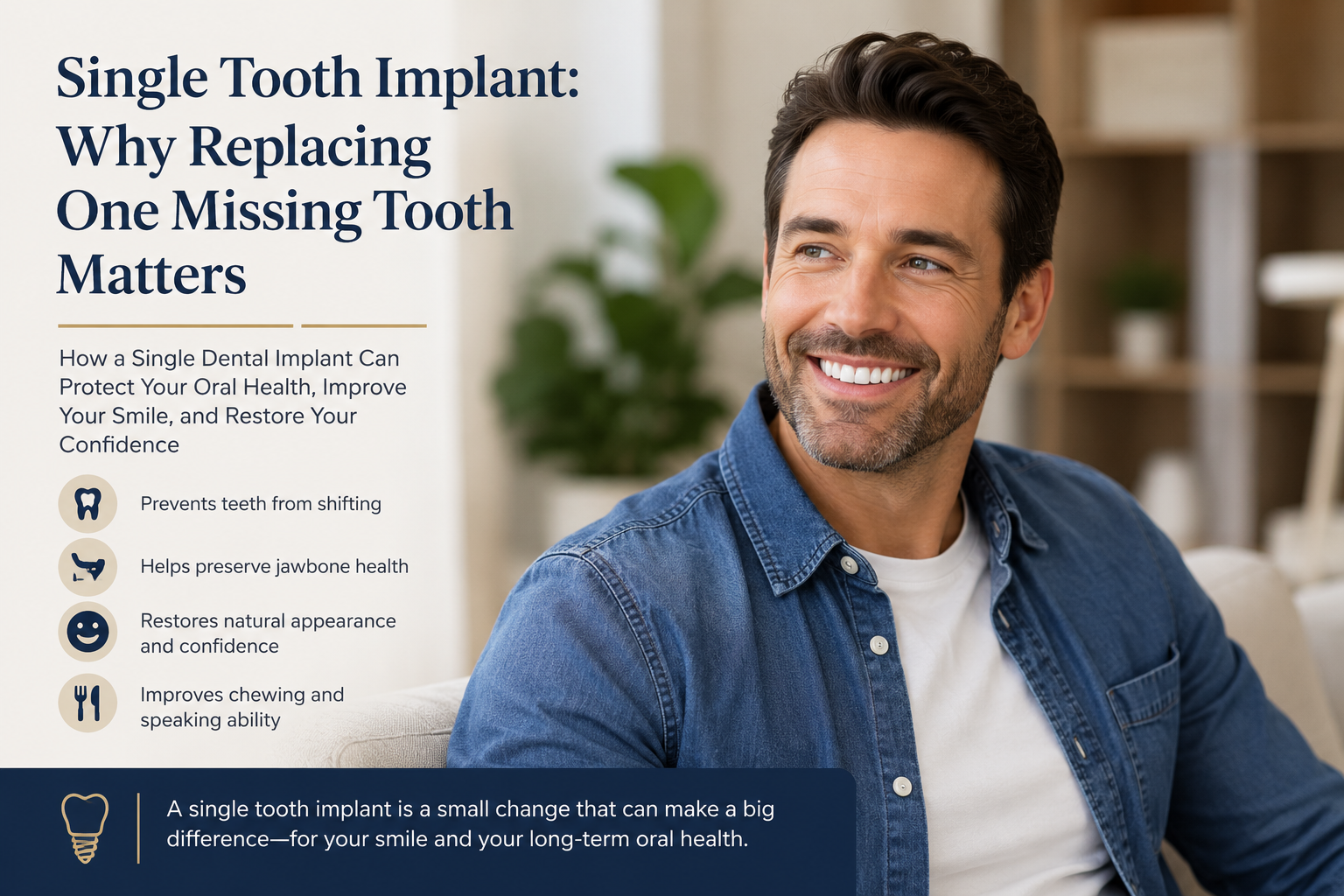
Losing one tooth may not seem like a major problem at first, especially if the gap is toward the back of your mouth. You may still be able to chew, speak, and smile without much discomfort. Because of that, many people delay replacing a single missing tooth.
But even one missing tooth can affect your oral health, bite, appearance, and long-term dental function.
A single tooth implant is one of the most natural-looking and stable ways to replace one missing tooth. It is designed to replace both the visible tooth and the missing tooth root, helping restore your smile while supporting the surrounding teeth and jawbone.
At Park Ave Dental Aesthetics, patients can learn more about dental implants in Weehawken and whether a single tooth implant is the right solution for their smile.
What Is a Single Tooth Implant?
A single tooth implant is a dental implant used to replace one missing tooth. It typically includes three main parts:
- The dental implant post
- The abutment
- The dental crown
The implant post is placed into the jawbone to act like an artificial tooth root. After the implant heals and bonds with the bone, an abutment is attached. A custom crown is then placed on top to restore the appearance and function of the missing tooth.
The result is a replacement tooth that looks, feels, and functions much like a natural tooth.
Why Replacing One Missing Tooth Is Important
It is easy to think that one missing tooth is only a cosmetic issue. In reality, a missing tooth can create a chain reaction inside your mouth.
Your teeth work together as a system. When one tooth is lost, the surrounding teeth, bite, gums, and jawbone can all be affected over time.
Replacing one missing tooth can help:
- Prevent nearby teeth from shifting
- Maintain proper bite alignment
- Restore chewing function
- Protect jawbone health
- Improve smile appearance
- Reduce stress on surrounding teeth
- Support long-term oral health
The sooner a missing tooth is evaluated, the easier it may be to prevent additional dental problems.
What Happens If You Do Not Replace One Missing Tooth?
When a tooth is missing, nearby teeth may gradually move into the empty space. This can cause crowding, gaps, bite changes, and uneven pressure when chewing.
Over time, an untreated missing tooth may lead to:
- Teeth shifting out of position
- Bite misalignment
- Jaw discomfort
- Food getting trapped in the gap
- Increased plaque buildup
- Difficulty chewing on one side
- Bone loss in the missing tooth area
- Changes in smile appearance
A missing tooth can also affect the opposing tooth. For example, if a lower tooth is missing, the upper tooth above it may begin to shift downward because it no longer has a tooth to meet when biting.
This is why replacing a single missing tooth is not just about filling a gap. It is about protecting the balance of your entire mouth.
How a Single Tooth Implant Helps Protect the Jawbone
One of the biggest advantages of a dental implant is that it replaces the missing tooth root.
Natural tooth roots stimulate the jawbone when you chew. When a tooth is lost, that stimulation stops. Over time, the bone in that area may begin to shrink.
A dental implant helps provide stimulation to the jawbone in a way that other tooth replacement options do not. This can help maintain bone volume and support facial structure.
This is one reason implants are often recommended for patients who want a long-term tooth replacement option.
Single Tooth Implant vs. Dental Bridge
A dental bridge is another common option for replacing one missing tooth. A traditional bridge uses the neighboring teeth to support a replacement tooth.
Both options can restore your smile, but they work differently.
A single tooth implant stands independently. It does not usually require reshaping the teeth next to the missing space. This can help preserve more natural tooth structure.
A dental bridge may be a good option in some cases, especially when neighboring teeth already need crowns. However, if the nearby teeth are healthy, some patients prefer an implant because it does not rely on those teeth for support.
When comparing a single tooth implant and a bridge, your dentist may consider:
- The health of neighboring teeth
- Bone support
- Gum health
- Bite alignment
- Cosmetic goals
- Treatment timeline
- Cost
- Long-term maintenance
Park Ave Dental Aesthetics offers restorative dentistry in Weehawken for patients who need to repair or replace damaged and missing teeth.
Single Tooth Implant vs. Partial Denture
A partial denture is a removable appliance that can replace one or more missing teeth. It may be less expensive upfront, but it usually does not provide the same stability as an implant.
A single tooth implant is fixed in place and does not need to be removed for cleaning. It also feels more natural for many patients when eating and speaking.
A partial denture may be helpful for some patients, especially if they are not candidates for implant surgery or need a temporary option. However, for patients who want a stable and natural-feeling replacement, a single implant is often preferred.
Park Ave Dental Aesthetics has also compared dental implants vs. dentures for patients deciding between different tooth replacement options.
Does a Single Tooth Implant Look Natural?
Yes. A single tooth implant can look very natural when carefully planned and restored.
The final crown is customized to match the shape, size, and shade of your surrounding teeth. The goal is for the replacement tooth to blend into your smile rather than stand out.
This is especially important when replacing a front tooth. For visible areas of the smile, your dentist will consider gum shape, tooth color, tooth proportions, and facial balance.
For patients focused on appearance, dental implants may also be part of a broader cosmetic dentistry plan.
Is a Single Tooth Implant Comfortable?
Once healed, a single tooth implant should feel comfortable and stable. Because it is anchored in the jawbone, it does not shift like a removable appliance.
Most patients adjust well to their implant crown. After the final restoration is placed, the implant is used like a natural tooth for chewing and speaking.
The implant itself does not have nerves like a natural tooth, but the surrounding gums and bite still need to be monitored. Routine dental visits are important to make sure the implant and surrounding tissue remain healthy.
Who Is a Good Candidate for a Single Tooth Implant?
You may be a good candidate for a single tooth implant if you are missing one tooth and have healthy gums, enough jawbone support, and good overall oral health.
Good candidates often:
- Have one missing tooth
- Want a fixed replacement
- Have healthy gums
- Have adequate bone support
- Want to avoid removable appliances
- Want to preserve nearby teeth
- Are committed to good oral hygiene
- Are healthy enough for implant treatment
If you have gum disease, bone loss, or other dental concerns, you may still be a candidate after additional treatment.
Park Ave Dental Aesthetics has a helpful article on who is a good candidate for dental implants that explains what dentists evaluate before recommending treatment.
What If the Tooth Still Needs to Be Removed?
Some patients are not missing a tooth yet but have a tooth that cannot be saved. This may happen because of severe decay, fracture, infection, trauma, or advanced gum disease.
In these cases, the damaged tooth may need to be extracted before an implant can be placed.
Depending on your situation, your dentist may discuss:
- Tooth extraction
- Bone grafting
- Temporary tooth replacement
- Implant timing
- Healing time
- Final crown placement
In some cases, implant placement can happen soon after extraction. In others, the area may need to heal first.
Do You Need Bone Grafting for a Single Tooth Implant?
Not everyone needs bone grafting, but some patients do.
A bone graft may be recommended if there is not enough bone to support the implant. This can happen if the tooth has been missing for a long time, if there was infection, or if gum disease caused bone loss.
Bone grafting helps rebuild the area and improve the foundation for implant placement.
Your dentist can evaluate your bone support with an exam and imaging before creating a treatment plan.
What Is the Process for Getting a Single Tooth Implant?
The process may vary depending on your oral health, but a single tooth implant usually involves several steps.
1. Consultation and Exam
Your dentist examines your teeth, gums, bite, and jawbone. This visit helps determine whether you are a good candidate for a dental implant.
2. Digital Imaging and Planning
Imaging helps your dentist evaluate bone support and plan the implant position. Advanced dental technology can make treatment planning more accurate and comfortable.
Park Ave Dental Aesthetics explains more about the role of modern technology in its article on digital dentistry.
3. Tooth Extraction, If Needed
If the damaged tooth is still present, it may need to be removed before implant placement.
4. Bone Grafting, If Needed
If the bone is not strong enough or thick enough, a bone graft may be recommended.
5. Implant Placement
The implant post is placed into the jawbone. After placement, the area needs time to heal.
6. Healing Period
During healing, the implant bonds with the jawbone. This process is important because it creates the stable foundation for the final crown.
7. Abutment and Crown
Once healing is complete, the abutment and custom crown are attached. The crown is designed to blend with your surrounding teeth.
How Long Does a Single Tooth Implant Take?
The timeline depends on your specific case.
If you do not need extraction or bone grafting, the process may be shorter. If you need preparatory treatment, healing time may extend the timeline.
A single tooth implant can take several months from start to finish because the implant needs time to integrate with the bone before the final crown is placed.
Your dentist can give you a clearer timeline after your consultation.
How Much Does a Single Tooth Implant Cost?
The cost of a single tooth implant depends on several factors, including whether you need extraction, bone grafting, imaging, the implant post, the abutment, and the final crown.
Because each case is different, the best way to understand cost is to schedule a consultation.
Park Ave Dental Aesthetics has already covered dental implant cost in Weehawken for patients who want a deeper breakdown of pricing factors.
Is a Single Tooth Implant Worth It?
For many patients, a single tooth implant is worth it because it restores more than appearance.
A dental implant can help protect the surrounding teeth, support the jawbone, restore chewing ability, and provide a natural-looking result.
Benefits of a single tooth implant include:
- Fixed replacement
- Natural appearance
- Strong chewing function
- Jawbone stimulation
- No need to reshape neighboring teeth
- Long-term durability with proper care
- Improved confidence
Although implants may cost more upfront than some alternatives, they can provide strong long-term value for patients who want a stable and lasting tooth replacement option.
How to Care for a Single Tooth Implant
A single tooth implant should be cared for with consistent oral hygiene and routine dental visits.
To protect your implant:
- Brush twice daily
- Floss around the implant
- Use recommended cleaning tools
- Keep routine dental checkups
- Avoid smoking
- Manage gum health
- Wear a nightguard if you grind your teeth
- Report pain, swelling, or looseness
Dental implants cannot get cavities, but the gums and bone around them can still become inflamed or infected. Park Ave Dental Aesthetics has an article on peri-implantitis that explains how to protect dental implants over time.
What Happens If You Wait Too Long?
Waiting too long to replace a missing tooth can make treatment more complicated.
The surrounding teeth may shift, the opposing tooth may move, and the jawbone in the missing tooth area may shrink. These changes can affect your bite and may increase the need for additional treatment later.
Delaying care may lead to:
- More complex implant planning
- Need for bone grafting
- Bite correction
- More restorative treatment
- Higher overall treatment costs
Park Ave Dental Aesthetics has discussed this in its article on the real cost of avoiding the dentist, which explains how untreated dental problems can become more serious over time.
Single Tooth Implant in Weehawken, NJ
If you are missing one tooth, a single tooth implant may be one of the best ways to restore your smile and protect your oral health.
Park Ave Dental Aesthetics provides dental implant consultations for patients in Weehawken and nearby areas, including Union City, West New York, Guttenberg, Hoboken, and Jersey City.
To learn more, visit the dental implants page or contact Park Ave Dental Aesthetics to schedule an appointment.
Final Thoughts
One missing tooth can affect your entire mouth. It can cause nearby teeth to shift, change your bite, reduce chewing comfort, and contribute to jawbone loss.
A single tooth implant can replace the missing tooth root and visible crown, helping restore function, appearance, and long-term stability.
If you are missing one tooth or have a tooth that may need to be removed, schedule a consultation to learn whether a single tooth implant is right for you.
FAQ: Single Tooth Implants
What is a single tooth implant?
A single tooth implant is a dental implant used to replace one missing tooth. It includes an implant post, abutment, and custom crown.
Is a single tooth implant better than a bridge?
A single tooth implant may be better for patients who want to replace one tooth without reshaping the neighboring teeth. A bridge may be better in some cases depending on tooth health, cost, and treatment goals.
Does a single tooth implant look natural?
Yes. The final crown is customized to match the size, shape, and color of nearby teeth so it blends naturally with your smile.
How long does a single tooth implant take?
A single tooth implant can take several months from consultation to final crown placement. The timeline depends on whether extraction, bone grafting, or additional healing time is needed.
Do I need a bone graft for one dental implant?
Some patients need bone grafting if there is not enough jawbone to support the implant. Your dentist can determine this with an exam and imaging.
Can I get an implant right after tooth extraction?
Sometimes an implant can be placed soon after extraction, but not always. The timing depends on bone health, infection, gum condition, and the treatment plan.
What happens if I do not replace one missing tooth?
Nearby teeth may shift, your bite may change, food may get trapped, and bone loss may occur in the missing tooth area.
Is a single tooth implant permanent?
A dental implant is designed to be a long-term tooth replacement solution. With proper care, implants can last many years.
How do I care for a single tooth implant?
Brush, floss, keep routine dental visits, avoid smoking, and follow your dentist’s maintenance instructions to keep the gum and bone around the implant healthy.
Where can I get a single tooth implant in Weehawken, NJ?
Park Ave Dental Aesthetics offers dental implant consultations in Weehawken, NJ for patients who need to replace one missing tooth with a stable, natural-looking solution.