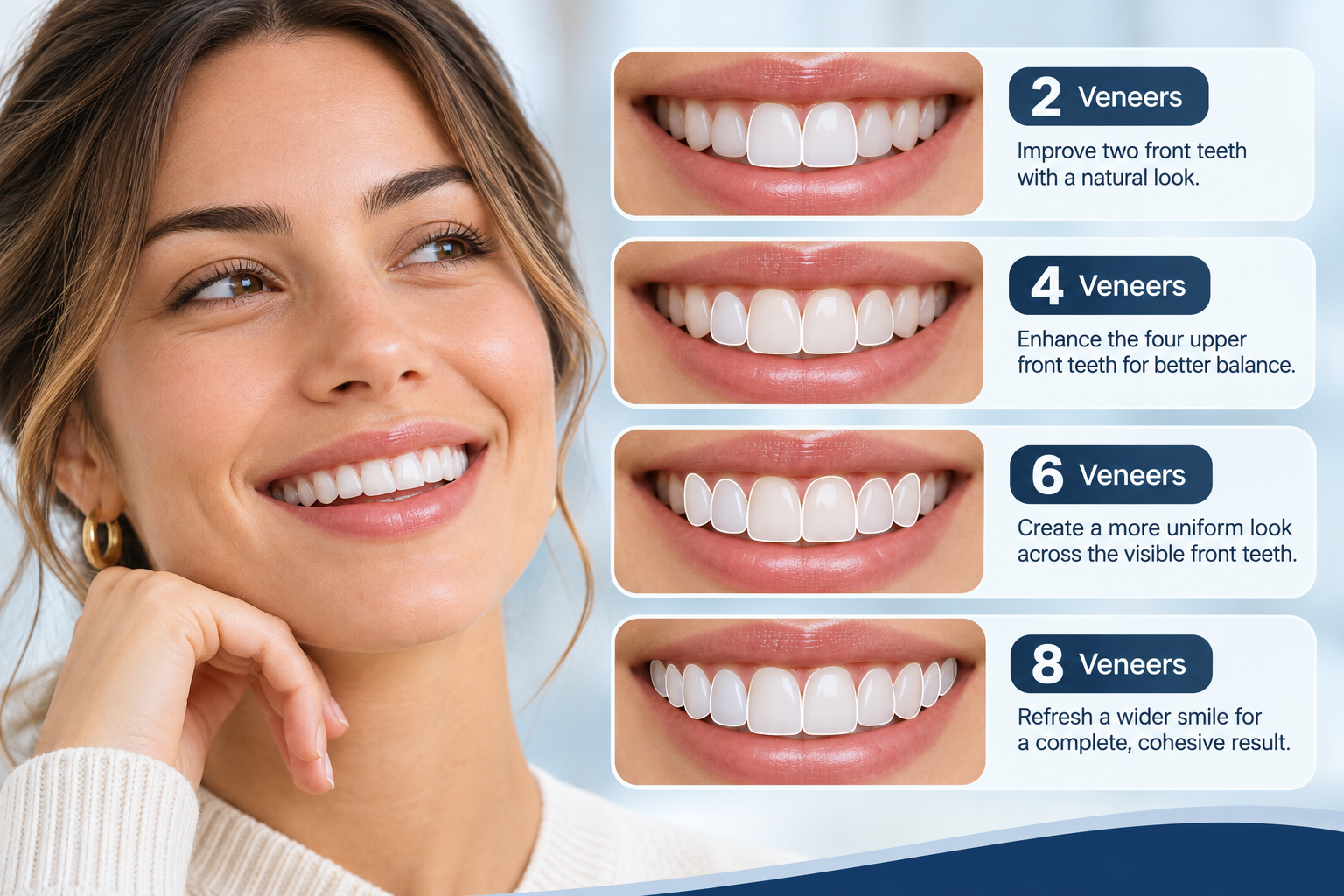
Thinking about getting porcelain veneers but wondering how many teeth actually need treatment? Some patients only want to improve one or two front teeth, while others are considering four, six, eight, or more veneers for a complete smile transformation. The right number depends on your smile, tooth shape, cosmetic goals, and how many teeth are visible when you smile.
One of the most common questions patients ask when considering cosmetic dentistry is, “How many veneers do I need?” The answer may be fewer than you think. A beautiful smile does not necessarily require veneers on every visible tooth.
For some patients, correcting one or two noticeable imperfections may be enough. Others may benefit from a coordinated treatment plan involving several teeth to create a balanced, natural-looking appearance.
At Park Ave Dental Group in Weehawken, NJ, cosmetic treatment planning focuses on your individual smile, facial features, oral health, and goals. If you are considering porcelain veneers, understanding how dentists determine the number of veneers can help you make a more informed decision.
How Many Veneers Do You Need?
There is no universal number of veneers that creates the best smile. Your dentist may recommend treating a single tooth, several front teeth, or a larger group of visible teeth depending on the cosmetic concern.
The number of veneers may depend on:
- How many teeth are visible when you smile
- Whether your concern involves one tooth or several
- The size and shape of your natural teeth
- Your existing tooth color
- Gaps, chips, wear, or uneven proportions
- How your upper and lower teeth meet
- Whether untreated teeth will blend with veneers
- Your budget and long-term maintenance preferences
Some patients want a subtle cosmetic improvement that keeps most of their natural teeth unchanged. Others want a more comprehensive smile makeover with coordinated tooth color, shape, and proportions.
The goal should be to treat the teeth that genuinely benefit from cosmetic improvement rather than automatically selecting a certain number.
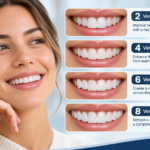
Comparing 2, 4, 6 and 8 Porcelain Veneers
Patients frequently hear about getting four, six, or eight veneers, especially when researching smile makeovers online. These numbers describe how many teeth are being restored, but they do not determine whether the treatment is appropriate.
Two Veneers
May be appropriate when two front teeth have noticeable differences in size, shape, color, or surface appearance.
Often considered for localized cosmetic changes rather than a comprehensive smile makeover.
Four Veneers
May be considered when the four upper front teeth are the primary cosmetic concern.
Can help coordinate the appearance of the central and lateral incisors when appropriate.
Six Veneers
May allow cosmetic treatment across the six upper front teeth, including the canine teeth.
Can be useful when more of the front smile needs coordinated color and shape.
Eight Veneers
May be considered when a wider smile reveals additional teeth toward the sides.
Can provide a coordinated cosmetic appearance across a broader visible smile area.
These are examples, not required treatment packages. Some smiles may benefit from fewer veneers, while others may require a different number or another treatment entirely.
When Are Two Veneers Enough?
Two veneers may be appropriate when the main concern involves two specific teeth, such as the upper central incisors. These are the two front teeth that often attract the most attention when someone smiles.
For example, a patient may have two front teeth that are noticeably discolored, uneven in length, or affected by cosmetic damage. If the surrounding teeth are healthy and naturally attractive, treating only the affected teeth may be a reasonable approach.
However, shade matching becomes especially important when only one or two teeth receive veneers. The porcelain needs to blend with the neighboring natural enamel so the restoration does not stand out.
Your dentist will also evaluate whether the teeth need veneers at all. For minor chips or small imperfections, dental bonding or another conservative treatment may be more suitable.
When Might Four Veneers Be Recommended?
Four veneers typically involve the upper central incisors and lateral incisors. These are the four front teeth that form an important part of the visible smile.
This approach may be considered when several front teeth have inconsistent shapes, noticeable wear, spacing, or discoloration.
For example, two central incisors may be slightly different lengths, while the adjacent teeth are narrow or uneven. Treating four teeth can sometimes create a more coordinated appearance.
However, the surrounding canine teeth still need to blend naturally with the treated teeth. If those teeth have a different shade or are very visible when smiling, your dentist may discuss additional options.
Why Smile Balance Matters
Cosmetic dentistry should consider how treated teeth blend with untreated teeth. The ideal result is not simply a row of identical white teeth, but a smile that complements your facial features and looks natural.
Are Six Veneers a Good Choice for a Smile Makeover?
Six veneers generally involve the six upper front teeth, extending from canine to canine. For some patients, this covers a substantial portion of the teeth visible when smiling.
Six veneers may be discussed when the cosmetic goals include improving the appearance of multiple teeth rather than correcting a small, isolated imperfection.
Potential concerns might include several worn edges, uneven tooth sizes, discoloration, or cosmetic asymmetry across the front of the smile.
Because canine teeth often influence the shape and character of a smile, careful planning is important. The dentist should evaluate their appearance, bite function, and how they relate to neighboring teeth.
Six veneers are not automatically preferable to four or eight. The number should follow the patient’s anatomy and treatment goals.
When Would Eight Veneers Make Sense?
Eight veneers may be considered when a patient has a wider smile that exposes more upper teeth, including the first premolars.
In these cases, treating only the front four teeth may create an obvious difference between the veneers and the natural teeth visible toward the sides.
A coordinated plan involving a wider group of teeth may help create a more consistent appearance when appropriate.
However, treating additional healthy teeth increases the amount of restorative work and the long-term commitment involved. Your dentist should explain why each proposed veneer is needed and whether a more conservative approach could achieve your goals.
Want to Know How Many Veneers Your Smile Needs?
A cosmetic consultation can help determine which teeth may benefit from veneers and whether bonding, whitening, or another treatment could be appropriate for the remaining teeth.
Request a Veneers ConsultationWhat Determines the Number of Veneers?
Rather than starting with a fixed number, an individualized veneer plan should begin with a careful evaluation of the smile.
1. How Many Teeth Show When You Smile?
Some people show only their six upper front teeth when smiling. Others naturally reveal more teeth along the sides of the mouth.
This visible area is sometimes called the smile zone. The size of your smile zone can influence how many teeth may need cosmetic changes to create a consistent appearance.
2. The Shape and Size of Your Teeth
Teeth naturally vary in shape and size. However, some patients have noticeable differences in tooth length, narrow lateral incisors, or worn edges that affect smile symmetry.
Veneers can sometimes improve these cosmetic characteristics, but not every tooth needs to be altered to achieve a balanced result.
3. Natural Tooth Color
If a patient wants significantly brighter veneers, the color of nearby natural teeth becomes especially important.
Porcelain veneers do not whiten in the same way natural enamel does. If untreated teeth are noticeably darker, the final smile may appear inconsistent.
In some cases, professional whitening may be recommended before veneers so fewer teeth need restorative treatment. The practice’s guide to veneers vs. teeth whitening explains when each option may be appropriate.
4. Bite and Alignment
Veneers improve the visible appearance of teeth, but they do not physically move teeth into a new position.
If your teeth are significantly crowded, rotated, or misaligned, your dentist may recommend orthodontic treatment before considering veneers.
This can help create a more conservative foundation for cosmetic treatment while addressing functional concerns.
5. Tooth and Gum Health
Healthy teeth and gums are essential for cosmetic treatment. Cavities, gum disease, active infection, or other oral health concerns should be evaluated before veneers are placed.
Some teeth may also have existing crowns or large restorations that require a different treatment approach. The final plan should account for the condition of every tooth involved.
Veneer Numbers at a Glance
| Number | Potential Treatment Area | Typical Planning Focus |
|---|---|---|
| 2 Veneers | Two selected front teeth | Localized cosmetic improvement |
| 4 Veneers | Four upper front teeth | Front-tooth symmetry and proportions |
| 6 Veneers | Upper front teeth, canine to canine | Broader smile coordination |
| 8 Veneers | Extended upper smile zone | Wider cosmetic smile design |
The right number may be different from these examples. The dentist should evaluate which teeth will actually be visible and how the proposed treatment will affect the overall smile.
Is It Better to Get More Veneers or Fewer Veneers?
More veneers do not automatically create a better smile. In cosmetic dentistry, a conservative treatment plan may be preferable when healthy teeth already look good.
Every porcelain veneer represents a long-term restoration that may eventually need maintenance or replacement. Traditional veneers also generally involve removing some enamel, which cannot grow back.
If two veneers can provide the desired improvement, there may be no need to treat six additional teeth.
On the other hand, if several visible teeth have significant cosmetic differences, treating a larger group may create a more harmonious appearance.
The most appropriate approach balances appearance, healthy tooth preservation, cost, and long-term maintenance.
Can You Combine Veneers With Other Cosmetic Treatments?
Yes. Some patients may achieve their goals with fewer veneers by combining treatment options.
Veneers + Whitening
Whitening may improve the color of natural teeth so the final restorations blend with the surrounding smile.
Veneers + Bonding
Bonding may be appropriate for small cosmetic repairs on teeth that do not require porcelain restorations.
Veneers + Invisalign
Clear aligners may improve tooth position before veneers are used for final cosmetic refinements.
Veneers + Smile Design
Digital planning can help evaluate proportions and visualize possible changes before treatment begins.
Combining treatments can sometimes help preserve healthy teeth while still addressing multiple cosmetic concerns.
Park Ave Dental Group has additional information about digital planning in its article on Smile Cloud Design.
How Does a Dentist Plan the Right Number of Veneers?
A veneer consultation should focus on more than choosing a number. The dentist needs to understand your goals and evaluate the structural and cosmetic condition of your teeth.
Discuss Your Smile Goals
Explain what you want to change, whether it is one uneven tooth, multiple chips, color, spacing, or overall smile symmetry.
Examine Teeth, Gums and Bite
Your dentist evaluates oral health, tooth structure, enamel, bite pressure, and any existing restorations that may affect the plan.
Evaluate the Smile Zone
Photos, digital scans, and smile analysis may help determine which teeth are visible and how they relate to your facial features.
Compare Treatment Options
The dentist explains whether veneers, bonding, whitening, alignment treatment, or a combination may help achieve your goals.
Review Cost and Long-Term Care
The proposed treatment should include an explanation of preparation, maintenance, potential replacement needs, and estimated costs.
Does the Number of Veneers Affect Cost?
Yes. The number of veneers is one of the factors that influences treatment cost. A plan involving eight veneers generally requires more restorations, materials, and laboratory work than a plan involving two veneers.
However, cost also depends on the complexity of the case, materials used, preparation requirements, and whether additional dental treatment is needed first.
When comparing options, patients should ask for an itemized treatment plan and understand what is included in the estimate.
Dental insurance may not cover veneers when they are considered cosmetic. Coverage depends on the specific circumstances and plan terms.
The best financial decision is not necessarily the smallest or largest number of veneers. It is the treatment plan that appropriately addresses your goals without unnecessary restorative work.
Do You Need Veneers on Your Bottom Teeth?
Not always. Many patients initially focus on their upper front teeth because those teeth are more visible when smiling.
However, some people also show their lower teeth while speaking or smiling. In those cases, the appearance of the lower teeth may become part of the cosmetic discussion.
Lower veneers require careful consideration of the bite, available enamel, tooth position, and the forces placed on the restorations.
Some patients may benefit from whitening, bonding, or orthodontic treatment instead of veneers on the lower teeth.
Your dentist can help determine whether treating both arches is appropriate or whether an upper-smile treatment alone may address your concerns.
How Long Do Multiple Porcelain Veneers Last?
The number of veneers does not determine their lifespan. Longevity depends on the quality of the restorations, fit, bite, oral hygiene, material, and individual habits.
Porcelain veneers can provide years of cosmetic function with appropriate care, but they are not permanent restorations that last forever without maintenance.
Helpful habits include:
- Brushing twice daily with fluoride toothpaste
- Flossing and cleaning between teeth
- Attending regular dental examinations
- Avoiding chewing ice or other very hard objects
- Not using your teeth to open packages
- Wearing a nightguard if recommended for grinding
- Reporting chips, looseness, or changes in your bite
Consistent care is important whether you have two veneers or a larger cosmetic restoration plan.
Questions to Ask Before Getting Multiple Veneers
Before choosing a veneer treatment plan, ask your dentist questions that clarify the reason for each proposed restoration.
- Which teeth actually need veneers?
- Would fewer veneers give me the result I want?
- Can whitening or bonding improve some of my other teeth?
- How much enamel would need to be removed?
- Will my untreated teeth blend with the veneers?
- Does my bite create any concerns for the restorations?
- Can digital smile design help me understand the proposed result?
- What maintenance and replacement costs should I expect?
These questions can help ensure that the proposed number of veneers reflects your individual dental needs rather than a standard cosmetic package.
The Best Number of Veneers Is Personal
Two veneers may be enough to improve a small cosmetic concern. Six or eight may be considered for a broader smile change. The right number is determined by your teeth, smile, bite, and treatment goals—not by a universal formula.
Final Thoughts: How Many Veneers Should You Get?
The ideal number of porcelain veneers depends on your natural smile and what you want to improve. Some patients may need only one or two teeth treated, while others may benefit from a coordinated plan involving several upper front teeth.
Whether you are considering two, four, six, or eight veneers, it is important to begin with a comprehensive dental evaluation. Your dentist can review your smile zone, tooth shape, color, bite, and oral health before recommending treatment.
At Park Ave Dental Group in Weehawken, NJ, patients can explore personalized cosmetic dentistry options designed around their individual needs.
If you are considering veneers, a consultation can help you understand how many teeth may benefit from treatment and whether a more conservative cosmetic option may also be appropriate.
Explore Porcelain Veneers in Weehawken, NJ
Ready to learn how many veneers may be right for your smile? Schedule a cosmetic consultation with Park Ave Dental Group to discuss your goals, treatment options, and personalized recommendations.
Schedule a ConsultationFrequently Asked Questions About the Number of Veneers
How many veneers do most people get?
The number varies depending on the smile and cosmetic goals. Some people receive one or two veneers for isolated concerns, while others may consider four, six, eight, or more. There is no standard number that is right for everyone.
Are four veneers enough for a smile makeover?
Four veneers may be enough when the four upper front teeth are the primary cosmetic concern. Whether that provides a balanced result depends on the teeth visible when you smile and the appearance of neighboring natural teeth.
Is it better to get six or eight veneers?
Neither number is automatically better. Six veneers may cover the six upper front teeth, while eight may be considered for a wider smile. Your dentist should recommend treatment based on your smile zone, tooth proportions, and oral health.
Can I get veneers on only two front teeth?
Yes. Two front teeth can sometimes be treated with veneers when the surrounding teeth are healthy and the cosmetic concerns are limited. Careful shade matching is important to help the restorations blend naturally.
Do I need veneers on every tooth that shows when I smile?
No. Veneers are not necessarily needed on every visible tooth. Whitening, bonding, or leaving healthy teeth untreated may be appropriate depending on your cosmetic goals and dental evaluation.
Can you get veneers on just one tooth?
Yes. A single veneer may be considered for one discolored, chipped, worn, or uneven tooth. Achieving a natural color and shape match with surrounding teeth is particularly important.
How do I know how many veneers will look natural?
Your dentist can evaluate your smile width, tooth color, size, proportions, gumline, and bite. Photographs and digital smile planning may help determine how many teeth would benefit from cosmetic treatment.
Does getting more veneers cost more?
Generally, more veneers increase the overall treatment cost because additional restorations are required. The exact price also depends on materials, case complexity, and any additional treatment.
Do I need veneers on my bottom teeth?
Not necessarily. Many patients only require treatment on selected upper teeth. Whether lower veneers are appropriate depends on visibility, tooth condition, bite, and cosmetic goals.
Can veneers and teeth whitening be combined?
Yes. Whitening may be recommended for natural teeth before veneers are placed so the final restorations can be matched to the preferred shade. The sequence should be determined by your dentist.
Do veneers require removing enamel?
Traditional porcelain veneers usually require some enamel preparation. Because enamel does not grow back, patients should understand the procedure and long-term maintenance considerations before treatment.
How can I find out how many veneers I need?
A cosmetic dental consultation is the best starting point. Your dentist can evaluate which teeth are visible, your oral health, bite, and smile goals before recommending the appropriate number of veneers or alternative treatments.